A speeding offence in the Netherlands is usually an administrative fine under the Wahv (the Wet Mulder), sent by the Central Judicial Collection Agency (CJIB) and without a criminal record. The exception: if you exceed the limit by more than 30 km/h, or by more than 40 km/h on a motorway, the case becomes a criminal matter for the Public Prosecution Service (Openbaar Ministerie), with a possible driving ban and an entry in your judicial record.
This article explains the speed limits, the 2026 fines, how to appeal within six weeks, and what happens when the police take your licence.
Нидерландияда ылдамдык чеги кандай?
Unless signs say otherwise, the limit is 50 km/h in built-up areas and 80 km/h outside them. Many urban streets are 30 km/h and many rural roads 60 km/h.
On most motorways the limit is 100 km/h between 06:00 and 19:00, and up to 130 km/h outside those hours where signs allow it. In a residential zone (woonerf) you drive at walking pace. Matrix signs and signs at roadworks take precedence, and speeding at roadworks costs more.
How much is a speeding fine in 2026?
The fine depends on the corrected excess and the type of road: 10 km/h too fast in a built-up area costs €95, 20 km/h costs €255. The CJIB adds €9 in administration costs to every fine.
| Ашыкча оңдолгон | Курулган аймак | Курулуш аянтынын сыртында | Автомобиль жолу |
|---|---|---|---|
| 10 км / ч | €95 | €89 | €84 |
| 20 км / ч | €255 | €243 | €229 |
| 30 км / ч | €446 | €424 | €389 |
| 35 км / ч | кылмыш иши козголду | кылмыш иши козголду | €488 |
These are the 2026 tariffs, excluding the €9 administration costs. The amounts rise with every km/h between these points. Above 30 km/h (or 40 km/h on a motorway) there is no fixed tariff: the public prosecutor sets the penalty in a punishment order (strafbeschikking), or the court decides.
Is there a tolerance on speed cameras?
There is no free margin, but the measured speed is corrected in your favour: 3 km/h is deducted below 100 km/h and 3 percent at 100 km/h and above. The fine is based on that corrected speed, which is the figure printed on the decision.
Who has to pay a Wahv speeding fine?
The registered keeper of the vehicle at the time of the offence pays, whether or not they were driving. That is why camera enforcement works without stopping the driver.
The keeper can escape liability only in defined situations, for example by showing that the car was stolen and reported to the police, or was in the hands of a lessee or garage. Simply saying that someone else was driving is not enough. For a rental car, the fine goes to the rental company, which usually passes on your details and may charge its own fee.
Айдоочу катары эмнени текшеришиңиз керек?
- The registration number, date, time and location on the decision.
- The corrected speed against the limit that actually applied at that spot.
- Whether the signs were present, visible and placed before the measurement point.
- The date on the decision (dagtekening): your six-week appeal period runs from that date.
- Whether your excess is close to the criminal threshold of 30 km/h, or 40 km/h on a motorway.
What should you check as a company or vehicle keeper?
- Who was using the car at the time, based on your fleet or lease records.
- Whether the car had already been sold or transferred in the RDW register on the date of the offence.
- Whether a theft was reported to the police before the offence date.
- Whether your employment or lease contract lets you recover the fine from the driver.
- Whether the fine is paid within eight weeks, to avoid the surcharges.
What happens if you do not pay on time?
You have eight weeks to pay. After the first reminder (aanmaning) the fine rises by 50 percent; after a second reminder the increased amount is doubled, so you pay three times the original fine.
Unpaid fines can end in seizure by a bailiff or detention. If you cannot pay at once, you can ask the CJIB for a payment plan. Always check payment requests on the CJIB website itself and never pay through a link in an unexpected message.
How do you appeal a speeding fine?
You lodge an appeal (beroep) with the public prosecutor (officier van justitie) within six weeks of the date on the decision. A late appeal is declared inadmissible unless the delay is excusable.
You can appeal digitally through the CJIB website or in writing. In the same letter, ask for the case file: the case overview (zaakoverzicht) and the photograph, if any. Arguing without those documents is guesswork. Ask for a hearing if your point is hard to explain in writing.
If the prosecutor rejects your appeal, you can go to the subdistrict court (kantonrechter) within six weeks of that decision. Above a statutory amount you must first provide security for the fine; you get it back if you win. A further appeal to the Court of Appeal Arnhem-Leeuwarden, which handles all Wahv appeals, is only possible above a threshold in the Wahv.
Lodging an appeal suspends the obligation to pay. Once the procedure ends against you, the payment period runs again and the surcharges apply automatically.
Which grounds succeed?
Grounds that succeed are factual or procedural. Examples are a wrong licence plate, a car already sold or stolen, signage that did not show the enforced limit, equipment outside its calibration period, or a decision taken without providing the file or holding a requested hearing.
The official report of a sworn officer is presumed to be accurate, so you need concrete facts and dated photographs, not a general denial. Arguments that fail: you did not notice, the road was empty, others drove faster, or the fine is high compared to your income.
When does speeding become a criminal offence?
Above 30 km/h over the limit, or 40 km/h on a motorway, the Wahv no longer applies and the Public Prosecution Service deals with the case under the Road Traffic Act 1994 (Wegenverkeerswet 1994). You then receive a punishment order or a summons to the police court.
A criminal disposal is recorded in your judicial documentation. Justis can take it into account when you apply for a certificate of conduct (Verklaring Omtrent het Gedrag, VOG), especially for jobs that involve driving. The court can also impose a driving disqualification (ontzegging van de rijbevoegdheid), alongside a fine or community service and partly suspended.
Speed combined with tailgating, dangerous overtaking or running a red light can amount to seriously dangerous driving under Article 5a of the Road Traffic Act 1994. Speed alone rarely meets that test. If you are unsure of your position, read when you are a suspect.
Do not ignore a punishment order. If you do not object within the statutory period, it becomes final and counts as a criminal disposal.
What happens when the police take your licence?
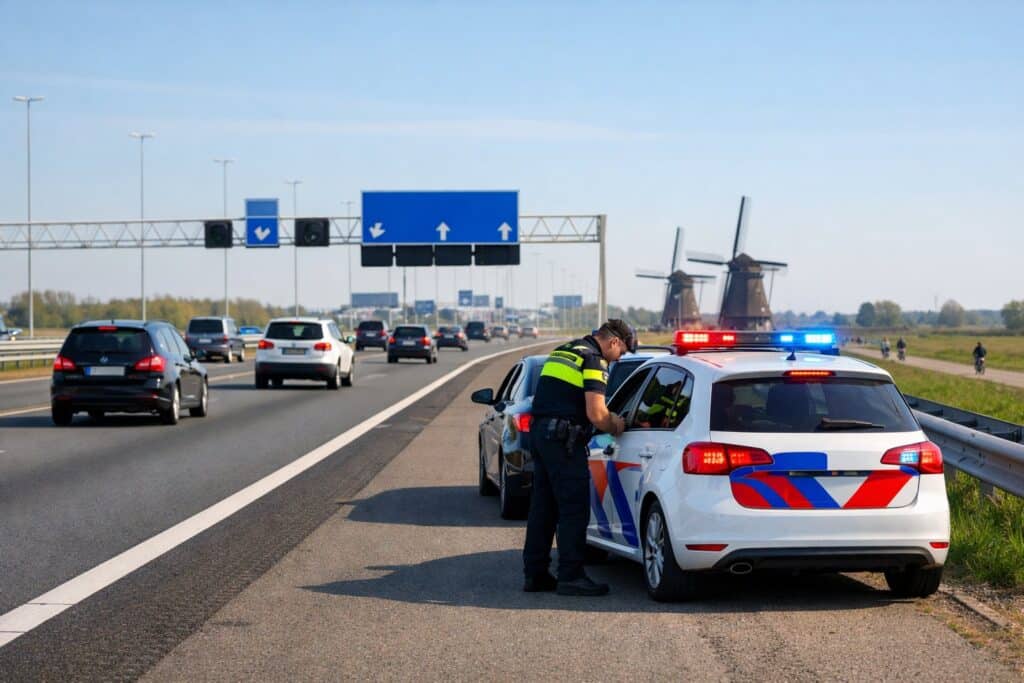
The police seize your licence at the roadside if you are stopped driving 50 km/h or more too fast, or 30 km/h or more on a moped. The public prosecutor then decides within ten days whether to keep it or give it back.
Until that decision you may not drive any motor vehicle, even for work. The prosecutor can keep the licence until trial, but must bring the case to court within six months of the seizure. You can file a complaint (klaagschrift) with the court to get the licence back.
The time you were already without a licence is deducted from any disqualification. Separately, the CBR (Centraal Bureau Rijvaardigheidsbewijzen) can require an educational course or a fitness examination at your own expense.
What about foreign drivers?
A foreign registration plate does not protect you. Under the EU cross-border enforcement rules, the Netherlands can trace the keeper through the registration authority of another member state and send the fine there.
A final financial penalty can also be enforced in your home member state under the EU rules on mutual recognition of financial penalties. A Dutch court cannot revoke a foreign licence, but it can ban you from driving in the Netherlands.
What can we do for you with a speeding fine or traffic case?
For an ordinary Wahv fine you rarely need a lawyer; our кылмыш юристтери help where your licence or record is at stake.
- We review the decision, the case file and the photograph, and tell you whether an appeal has a real ground.
- We draft the appeal to the public prosecutor or the subdistrict court within the six-week period.
- We file a complaint (klaagschrift) against the retention of your driving licence.
- We defend you against a punishment order or summons for excessive speed or dangerous driving.
- We advise you on the effect of a criminal disposal on your certificate of conduct.
Жыйынтык
- Most speeding offences are Wahv fines from the CJIB, with no criminal record; in 2026 10 km/h too fast in town costs €95 plus €9 costs.
- Above 30 km/h over the limit, or 40 km/h on a motorway, it becomes a criminal case for the Public Prosecution Service.
- Appeal a Wahv fine within six weeks of the date on the decision, and ask for the case file.
- At 50 km/h or more too fast the police take your licence; the prosecutor decides within ten days.
Көп берилүүчү суроолор
Нидерландияда ылдамдыкты жогорулатуу качан кылмыш болуп эсептелет?
When you exceed the limit by more than 30 km/h in or outside built-up areas, or by more than 40 km/h on a motorway. The Public Prosecution Service then deals with the case under the Road Traffic Act 1994, by a punishment order or a summons to court.
Ылдамдыкты ашыргандыгы үчүн айып пул мага соттолгондугун билдиреби?
Not if it is an ordinary administrative fine under the Wahv. A criminal disposal for excessive speeding is recorded in the judicial documentation and can be taken into account when you apply for a certificate of conduct (VOG).
How long do I have to appeal a speeding fine?
Six weeks from the date on the decision. You appeal to the public prosecutor, digitally or in writing, and ask for the case file. If the appeal is rejected, you have another six weeks to go to the subdistrict court.
Милиция айдоочулук күбөлүгүмдү качан алып коё алат?
When you are stopped driving 50 km/h or more too fast, or 30 km/h or more on a moped, and in cases of serious intoxication or dangerous driving. The public prosecutor decides within ten days whether to keep or return it.
Ылдамдыкты ашырганым үчүн айып пул төлөө үчүн адвокаттын жардамы керекпи?
Rarely for an ordinary Wahv fine. Legal help is worth it when your licence has been seized, when you receive a punishment order or summons, when the measurement is technically disputed, or when you are a repeat offender.